Compacted mortar bed
Drypack
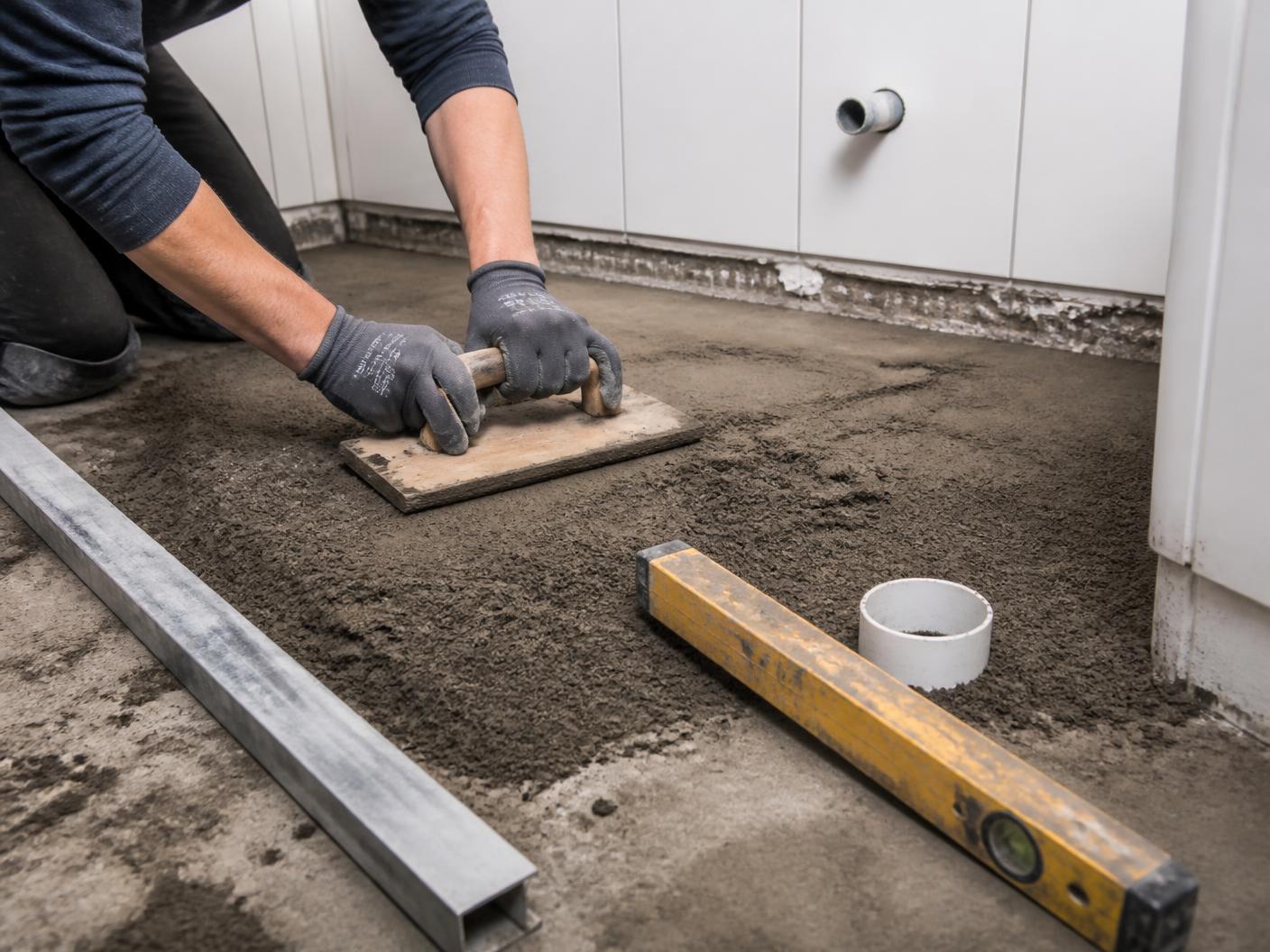
A stiff sand and cement mortar, packed by hand and screeded to a required plane or fall. Because it holds its shape rather than flowing, it can be shaped exactly where a poured material cannot.
What drypack is
Drypack — also called deck mud, dry-pack mortar or a floor mud bed — is a mixture of sand and cement with a deliberately low water content. Squeezed in the hand it holds together without releasing water, which is exactly the consistency that lets it be compacted and screeded rather than poured.
That property is the reason it is used. A mortar bed can be built up in thickness, set to a specific elevation, and shaped to a required plane or slope, then left to cure into a solid substrate for tile and stone.
Its role in shower and bathroom construction
In bathroom and shower construction, a drypack bed is what turns a rough or uneven structural floor into a flat, tile-ready surface at the elevation the design calls for — and, in a shower, into a floor that falls consistently toward the drain.
It also absorbs the practical problems of a real building: the transition between an existing floor and new work, the height difference at a doorway, or a structural surface that was never intended to be a finished plane.
- Bringing a floor to a required plane or elevation
- Building the sloped base of a shower floor
- Creating a substrate over a structural surface that is out of tolerance
- Managing height transitions between adjoining areas
Why precision matters
A mortar bed is the last layer that can be shaped. Once tile is set, the plane beneath it is fixed — a hollow, a dip near a drain or a bed that runs off level cannot be corrected without removing the finish.
Where a slope is required, consistency matters as much as the amount of fall. An even plane from the perimeter to the drain drains predictably; a plane that flattens partway does not.
How the work generally proceeds
The bed is set out first — elevations, perimeter reference points and, where relevant, the drain height. The mortar is then mixed, placed, compacted and screeded off the reference points, and the surface is checked before it is left to cure.
- Confirm the substrate, available height and finished elevation
- Establish reference points, screed rails and — where relevant — drain height
- Place, compact and screed the mortar to the set plane or fall
- Check the surface and allow the bed to cure before the next stage
Questions
Drypack FAQs
Related services
- Read more
Scratch Coat
A keyed cement mortar base coat applied over lath or a prepared substrate to create a flat, mechanically sound surface for the layers that follow.
- Read more
Membrane
Waterproofing membrane work for wet areas — applied over prepared substrates so water is managed at the correct layer of the assembly.
- Read more
Shower Drypack
Shower floor and base preparation: drypack mortar packed and screeded to consistent slope toward the drain, ready for the finishing trades.
Request a Quote
Planning a shower or substrate build?
Send the project details and we will come back to you about scope, sequencing and scheduling.